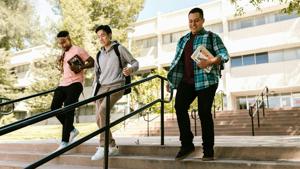
WATCH: Experts say increased spending doesn’t mean better students
Spending more taxpayer dollars doesn’t make kids smarter, according to experts.
As K-12 test scores and student proficiency rates continue to decline nationwide, education experts question whether increased education funding is improving student outcomes or merely contributing to inefficiencies within the public school system.
National Assessment of Educational Progress data released in 2024 show that the average reading score for 12th-grade students fell three points since 2019 and is 10 points lower than the first assessment in 1992. Average math scores for 12th graders have also declined by three points since 2019.
Critics argue the issue is not a lack of funding, but how education dollars are being spent
“We don’t have an education funding problem. We have an education spending problem,” Ryan Walters, CEO of Teacher Freedom Alliance, told The Center Square.
Walters said increased funding has often gone toward administrative bloat rather than students and teachers. He said schools should be raising academic standards, improving accountability and implementing school choice programs to give parents more control over their children’s education.
“School choice is a huge factor in this. We need that universally across the country so that if schools are low performing and they don’t want to shape up, parents should be able to take their kids somewhere else,” Walters said.
School choice also puts parents in the driver seat of their kids’ education, which can impact administrators responsiveness to decision making, Walters added.
Nationally, public K-12 schools spent almost $1 trillion in 2024, while the average per-pupil spending nears $18,000. According to the National Center for Education Statistics, public school revenue increased 16% between the 2010 and 2020 school years, adjusting for inflation.
Patrick Graff, senior fellow with the American Federation for Children, said the decline in student performance began before the COVID-19 pandemic.
Graff pointed to chronic absenteeism, increased classroom screen time and declining academic standards as major contributors to lower performances. According to NAEP, 31% of 12th-grade students reported missing three or more days of school in the month before taking the 2024 assessment.
Graff said accountability systems have weakened over time, as schools focus more on graduation rates and metrics. He pointed to the expansion of credit recovery programs, which allow students who fail a class to complete online coursework to regain credit.
“A graduation rate used to be a much stronger signal in terms of how well a high school is able to move their kids through and get them to reach a bar or graduation,” Graff said. “And over time, a lot of the standards underneath that high school graduation metric have really eroded.”
To ensure accountability, Graff said, schools should receive meaningful feedback from students, parents and teachers to encourage long-term academic growth rather than just meeting performance benchmarks.
Graff noted spending more money does not solve the underlying issues in public education.
“That is a big kind of background crisis within education right now. A lot of people are calling to just spend more, and they just trust that that will lead to better outcomes,” Graff said. “But there are many states in which they have spent a lot more, and they’re doing a good bit worse.”
Graff pointed to Oregon as a “cautionary tale.”
Oregon
In Oregon, inflation-adjusted education spending has increased by roughly 45% over the past decade.
Per-pupil spending reached $17,988 during the 2022-23 school year, nearly double the amount spent two decades earlier, according to Common Sense Institute. Despite the increase, Oregon ranked in the bottom nationally in academic outcomes.
Statewide testing in Oregon showed 42.5% of students were proficient in English language arts and 31% were proficient in math.
The solution can’t be throwing more money into a broken system, Graff said.
“I think that has been the case in a lot of states where you don’t have a system that is responsive enough to parents and students and their needs, and instead being more responsive to the needs of adults in the system,” he said.
The Center Square reached out to the Oregon Department of Education, but did not receive a response.
Arizona
Arizona Superintendent of Public Instruction Tom Horne said that while increased education spending can be useful, accountability is necessary.
“Increased spending can have the effect of raising student performance, but only if it’s used properly to have the academic result,” Horne told The Center Square in an exclusive interview. “Just spending by itself without any accountability can be a waste of money.”
Horne emphasized that his work in Arizona is focused on ensuring education funds are directed toward improving academic performance while maintaining accountability standards.
Like many other education experts, Horne argues that school choice can help restore high academic standards and create healthy competition among schools and students.
While proficiency levels remain below 50% in math and English, Arizona ranks second in the nation in education freedom, as previously reported by The Center Square. Arizona is set to spend $10 billion on K-12 spending, including $1 billion on a school choice program for the 2026 fiscal year.
“School choice will improve public education because competition makes everybody perform better,” Horne said.
Many people have lost the care of providing good education and getting kids to learn as much as possible, Horne noted. “A lot of people have lost that focus, and I’m trying to get that focus back.”
California
Results from the 2025 Smarter Balanced assessments show that 49% of California students met or exceeded state standards in English language arts, while 37% met or exceeded standards in math, according to the Public Policy Institute of California.
The results come as many California school districts continue to increase education spending while also facing budget deficits.
The Los Angeles Unified School District, the nation’s second-largest school district, projects a $1.6 billion budget deficit by the 2027-28 school year. District officials have attributed the shortfall largely to declining enrollment, which has fallen 46% since 2001 and the end of pandemic relief funding.
The Center Square reached out to LAUSD for an interview to discuss student proficiency, but the district declined the interview and instead provided statements on how student performance has improved since the pandemic.
The district reported that 46% of students met or exceeded standards in English language arts, up 3.4 percentage points from the previous year and above pre-pandemic levels.
In math, 36.76% of students met or exceeded standards, an increase of 3.93 percentage points from the prior year. Science scores also improved, with 27.28% of students meeting standards.
Lance Izumi, senior director of education studies at Pasadena-based Pacific Research Institute, said the gap between education spending and student outcomes remains a concern.
“It’s very difficult to look at these cries for more funding as anything more than just funding the adults in the system and not helping the students,” Izumi told The Center Square.
Izumi also said public schools are facing growing competition from charter schools, private schools and homeschooling options.
Florida
Graff pointed to Florida as an example of a state that has achieved higher student outcomes despite comparatively lower per-pupil spending.
State assessment data showed English language arts proficiency rose to about 57% in 2025, up from 53% in 2024. Math proficiency increased to roughly 59%, compared with 56% the previous year.
According to the Education Data Initiative, Florida spent about $12,689 per student and ranked 47th nationally in K-12 education funding and 46th in spending. Florida ranked 22nd overall in pre-K through 12th-grade education in the latest U.S. News & World Report education rankings.
Illinois
In Illinois, 41% of students in grades three through eight were reading at grade level in 2024, while 31% of 11th-grade students met proficiency standards in reading, according to data by the Illinois Report Card.
In math, 38% of students in grades three through eight were proficient, along with 39% of 11th graders in 2025.
At the same time, one Illinois school district has significantly higher performance metrics.
The top school district nationally is Glenbrook High School District 225 in Illinois. The clearest pattern is consistent strength across multiple categories, according to Niche, an organization that takes public data to rank and profile K-12 schools and colleges across the United States.
Zach Chatham, public relations manager at Niche, told The Center Square that the company’s Best School Districts rankings are based on a combination of academic performance, student experiences and survey responses.
Chatham said top-ranked districts generally perform well across multiple categories, including Advanced Placement participation and exam performance, teacher satisfaction and salaries, extracurricular activities, facilities, athletics and parent and student survey feedback.
“The rankings are designed to reflect the overall student experience and outcomes holistically, rather than district scale, visibility or national influence alone,” Chatham said.
Ryan Bretag, assistant superintendent of teaching and learning for Glenbrook High School District 225, told The Center Square in an exclusive interview that the district emphasizes what he described as the four A’s: academics, athletics, activities and the arts.
According to district data, Glenbrook High School District 225 reports a 96% graduation rate, with 84% reading proficiency and 80% math proficiency.
While the national average for per-pupil spending is $18,000, the Glenbrook district spends roughly $30,000 per student.
Bretag told The Center Square that community engagement is central to the district’s approach. He added that the district prioritizes gathering community feedback and refining its strategies as part of a broader effort to strengthen the community overall.




Isolated Rain Showers then Partly Cloudy
Latest News Stories

Trump targets 60 economies with forced labor tariffs
Lawmakers probe $1.2B Ohio Medicaid fraud

Debt burden, pensions burden Chicago Public Schools

Nearly 100,000 Illinois Uber, Lyft drivers may soon be able to unionize

Michigan lawmakers spar over Rx Kids program amid oversight concerns

UPDATED: Waters, other incumbents ahead in LA congressional races
GOP rep: New budget shows ‘addiction’ to taxes

Retirees face $5,500 average cut to annual Social Security benefits in 2032

Illinois Quick Hits: Comptroller Mendoza announces run for Chicago mayor
Georgia doctors face scrutiny as they cozy up to injury lawyers

Wiener, Gallagher, Gray lead in congressional races
Desmond, Wilpert ahead in District 48 race to succeed Issa