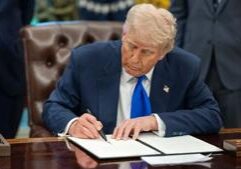
Trump says tariffs never came up during China trip
President Donald Trump said Friday that tariffs never came up during his two-day trip to China, even as his administration works to replace a tariff regime the U.S. Supreme Court struck down with a new one that could hit importers as early as July.
“We didn’t discuss tariffs,” Trump told reporters aboard Air Force One as the plane refueled in Anchorage, Alaska. Asked why, he responded: “Wasn’t brought up.”
Trump described the Beijing visit as “a very historic couple of days,” saying China agreed to purchase more than 200 Boeing aircraft – with a promise of up to 750 planes if the initial order goes well – along with about 400 to 450 General Electric engines.
He also said Chinese purchases of U.S. soybeans and agricultural products are forthcoming, telling reporters, “the farmers are going to be very happy.”
Although Trump didn’t talk about import taxes with China, his administration is working at home to rebuild the president’s tariff policy.
U.S. Trade Representative Jamieson Greer, who accompanied Trump on the trip, is leading that effort. Treasury Secretary Scott Bessent said in April that a new round of tariffs under Section 301 of the Trade Act of 1974, a separate legal authority, could take effect as early as July. The U.S. Trade Representative’s Office has opened investigations into 16 major U.S. trading partners, with hearings concluding last week.
Although Trump said tariffs didn’t come up while he was in China, the fight over import taxes has continued at home.
The U.S. Supreme Court struck down Trump’s earlier tariffs in February, ruling he exceeded his authority by using a 1977 emergency powers law to impose worldwide import taxes. Trump responded within hours by invoking a separate provision of the Trade Act of 1974 to impose a 10% global import duty.
That new tariff, known as the Section 122 tariff, is itself now being challenged in court. The U.S. Court of International Trade ruled 2-1 on May 7 that Trump again exceeded his authority. A federal appeals court has temporarily frozen that ruling while it considers the administration’s appeal.
The Yale Budget Lab projected the 150-day Section 122 tariff would generate about $30 billion in revenue for the federal government.
Greer warned in a May 11 court declaration that removing the tariffs during the appeal could derail ongoing trade negotiations. “If certain key trading partners walk away from the table now, these negotiations may never resume, even if higher courts conclude that the temporary import surcharge was lawful,” he wrote.
The U.S. Chamber of Commerce has urged the administration to prioritize tariff relief, warning that businesses, especially small businesses, face “growing costs and disruptions.”
Rep. Max Miller, R-Ohio, made a similar point directly to Greer at an April 22 House Ways and Means Committee hearing.
“This tariff policy, it isn’t working for them and it is not a net positive – it is a net negative,” Miller told Greer, asking him to open a waiver office for businesses that can’t pass tariff costs on to consumers.
Greer declined, saying Trump “personally has been very direct that he doesn’t want to do this.”
Multiple economic studies have concluded that U.S. businesses and consumers bear nearly the entire cost of tariffs. Analyses from the Federal Reserve Bank of New York, the Kiel Institute for the World Economy, and Duke University all reached that conclusion.
A The Center Square Voters’ Voice Poll conducted in March found that 42% of voters think U.S. consumers bear most tariff costs, while just 12% said foreign countries primarily pay them.




Mostly Sunny then Showers And Thunderstorms Likely
Latest News Stories
Meeting Summary and Briefs: Will County Board Executive Committee for October 9, 2025
Renovations at Veterans Assistance Commission and Court Annex on Track for Winter Completion
Will County Considers First Update to Wastewater Ordinance Since 2016
IDOT Plans to Invest Over $1.3 Billion in Will County Roads Through 2031
Committee Advances 50% Increase in Mental Health Levy on 4-3 Vote
Will County Poised to Launch Major Mental Health Initiative Based on Joliet Program’s Success
Looming State Energy Bill Threatens to Further Limit County Control Over Solar and Wind Projects
Controversial Immigrant Rights Resolution Postponed by Will County Board After Heated Debate
Will County’s Gas-to-Energy Plant Reports Nearly $460,000 Net Loss Amid Operational Setbacks
Will County to Draft First-Ever Policy on Artificial Intelligence Use
Will County Sees 50% Drop in Opioid Deaths, But Alarming Rise in Suicides
Will County Board Backs Effort to Rename ‘Stigmatizing’ Chicago Sanitary and Ship Canal
Access Will County Dial-a-Ride on Track for Full County-Wide Service in 2026
Divided Will County Board Authorizes Condemnation for 143rd Street Widening