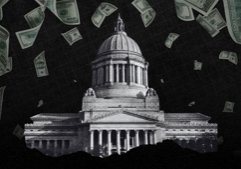
Report: U.S. added $1.2 trillion to national debt in six months
The U.S. government added $1.2 trillion to the national debt over the past six months, borrowing $163 billion during March alone, the Congressional Budget Office reports.
At the current rate of borrowing, federal deficits are on track to top $2 trillion by October, the end of the current fiscal year.
But the president’s recent budget request – which lawmakers will use as a blueprint for the 12 fiscal year 2027 appropriations bills – calls for $2.1 trillion in discretionary spending alone, without touching entitlement program spending.
“Both Congress and the President continue to ignore the urgent need to get our borrowing under control,” Maya MacGuineas, president of the Committee for a Responsible Federal Budget, said in a statement.
“As lawmakers consider the budget process for the upcoming fiscal year, we hope that they come up with plans to reduce deficits from the too-high 6% of GDP to a more sustainable 3% of GDP; secure our nation’s ailing trust funds for Social Security, Medicare, and highways; and ultimately fix the broken process that got us into this mess.”
Though CBO’s latest deficit estimate is $139 billion less than the amount recorded during the same time period last year, that is in large part due to increased tariff revenues and individual income or payroll taxes.
Federal spending, on the other hand, increased by $84 billion, mostly due to growing entitlement programs like Social Security, Medicare and Medicaid.
The government also collected 28% less in taxes from U.S. corporations over the last six months due to Republicans’ budget reconciliation bill – the “One Big Beautiful Bill” – which expanded deductions for certain corporate investments.
Yet despite repeated warnings from budget watchdogs, congressional action on soaring federal deficits and the over $39 trillion national debt ultimately hasn’t progressed past vigorous handwaving from a small group of Republicans.
Although the OBBB reduced federal spending by roughly $1 trillion over the next decade via entitlement program reforms, the savings only offset about a third of the bill’s $3.4 trillion ten-year cost.
Congress then sidestepped the automatic spending cuts to Medicare and other programs that are triggered by unpaid-for federal borrowing by wiping the Pay-As-You-Go (PAYGO) scorecard in November.
As House lawmakers return next week to begin hashing out appropriations funding and a second budget reconciliation bill, CRFB, the Cato Institute, and other budget watchdog groups are urging them to find at least $600 billion in savings.


Mostly Clear
Latest News Stories
New Lenox 122 Eyes Future Budget Cuts to Offset Full-Day Kindergarten Costs, Approves Quad Plus Tax Abatement

Minooka Blasts Five Home Runs to Overpower Lincoln-Way Central 12-2

New Lenox Seeks $2.5 Million State Loan for Water Main Replacements, Sets $1.2 Million in Sureties for Spencer Meadows
Board Approves $1.04 Million in New Curriculum for New Lenox District 122

Meeting Summary and Briefs: New Lenox Community Park District Board of Commissioners for February 18, 2026

Meeting Summary and Briefs: New Lenox Township Board of Trustees for February 12, 2026

Tingley’s Perfect 5-for-5 Day, Shutdown Bullpen Rally Lincoln-Way Central Past Joliet Catholic 13-6
New Lenox Mayor Slams Springfield Affordable Housing Proposal as “Garbage,” Board Passes Opposing Resolution

Frankfort Man Arrested by State Police for Threatening Governor Pritzker
St. Charles East Blanks Lincoln-Way Central 10-0 Behind Dominant Pitching and Majkszak’s Power
Meeting Summary and Briefs: Capital Improvements & IT Committee for March 3, 2026
New Lenox District 122 Approves Full-Day Kindergarten for 2027-2028, Extends Teacher Contract
New Lenox Park District Set to Launch Massive ADA Audits Across Dozens of Local Parks