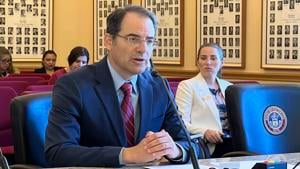
WATCH: Advocates urge SCOTUS for uniform gun law guidance
Advocates and legal experts urged the U.S. Supreme Court to adopt uniform gun laws across the country after justices heard arguments in a case on whether to uphold Hawaii’s gun control law.
Wolford v. Lopez challenges a Hawaii law that prevents concealed carry permit holders from going to gas stations, bars, restaurants that serve alcohol, beaches and public parks without written or verbal consent from the property owner.
During the arguments on Tuesday, several gun rights advocates came out to the steps of the Supreme Court to express support for Second Amendment protections.
“Private property owners certainly have the right to prohibit firearms on their own property, but it is gross overreach for the government to decide that for them,” said Katie Novotny, a demonstrator outside the court.
An argument analysts were particularly watching was in drawing a distinction between free speech rights and gun rights on private property open to the public. Carrie Severino, president of the Judicial Crisis Network, said without the state law store owners could still place signs restricting guns in their businesses.
“What’s not permissible is the state forcing you to put up the sign the other way and having the default be that no one may carry even with a valid permit on that private property,” Severino said.
Severino pointed out that Hawaii’s law comes with several logistical challenges in getting permission from a property owner. She said gun carriers would be hard pressed to obtain permission without already breaking the law.
Another significant portion of the justice’s arguments focused on what laws in the nation’s history should be used to understand the traditional application of the Second Amendment. Lawyers for Hawaii used examples of Black code laws – which prevented formerly enslaved African Americans from obtaining firearms – to assert a historical tradition of limiting firearms use.
“That just shows the weakness of their position,” Severino said. “If they had any better precedent to rely on, I’m sure they would not be stuck trying to hang their case on these racist laws from the mid-19th century.”
However, Justice Ketanji Brown Jackson appeared to indicate her support for including Black code laws in Hawaii’s justification.
“It was very shocking to hear Justice Jackson in particular defending the use of the racist post-civil war Black codes as body of law that we should be copying in any respect,” Severino said
Justice Clarence Thomas appeared to call for the consideration of later laws like the 14th Amendment that were designed to undo Black codes.
Lawyers for Hawaii also argued the law should remain in place because the state’s customs and culture do not assume most people carry guns with them. Severino said the justices should be focused on the Second Amendment’s customs and traditions rather than an individual state.
“When Hawaii joined the United States, they were adopting United States law as it stood then not not modifying it,” Severino said.
Legislators in California, Maryland, New Jersey and New York have also considered similar restrictions on concealed carry permit holders. Advocates called on the high court’s justices to clarify legal restrictions and provide uniformity among the states.
“We need guidance from the Supreme Court to understand what the outside contours of that are under the Constitution so the other states know what the limits are,” Severino said.

Patchy Fog then Partly Sunny
Latest News Stories
WATCH: Detransitioner gets a second chance at medical malpractice lawsuit
WATCH: CA Democrats pass congressional redistricting plan

Pew: U.S. immigrant population declines for first time in nearly 60 years

WATCH: Illinois’ FY23 financial audit released amid criticism of tardy reports

European Union says U.S. consumers will end up paying tariffs
Illinois quick hits: Anti-SLAPP bill signed; Chicago schools settles meditation case

U.S.-EU trade deal includes ceiling for European pharmaceutical imports
Supreme Court allows Trump to block DEI funding
Trump to probe Smithsonian museums for ‘woke’ ideology

Director: Nation’s largest outdoor ag show brings economic impact to central IL
NY appeals court overturns Trump’s civil fraud penalty
Pritzker: Fair maps in Illinois would be ‘disarming’ to Democrats