Policy expert: How will GOP pay for its plan to send tax dollars to flex spending plans?
Congressional Republicans are proposing sending government subsidies to flexible spending plans, with an expert suggesting that tax dollars saved by reducing Medicare fraud could be used to pay for the $30 billion a year move.
President & CEO of Proactive Strategy Group as well as healthcare policy expert Mark Merritt told The Center Square that two key questions for the plan are “how are they going to pay for it?” and “are the healthcare subsidies for anything or just Obamacare?”
The plan “doesn’t have a chance of passing, unless it’s going to be paid for somehow,” Merritt said, while explaining that extending Obamacare subsidies or the same amount of money for other healthcare would cost “about $30 billion a year.”
“There are a lot of Republicans in the House that are very, very concerned about the debt and the deficit,” Merritt said. “It only takes a few of them to not vote for this, so they’re going to want to see this paid for.”
Currently, the national deficit is at $1.78 trillion, which is down $41 billion from last year at the same time.
Merritt suggested to The Center Square that U.S. Sen. Bill Cassidy’s proposed No UPCODE Act could be “a great way to reduce wasteful spending to pay for this.”
The No Unreasonable Payments, Coding, or Diagnoses for the Elderly Act – or No UPCODE Act – was introduced by Cassidy, a Republican from Louisiana, earlier this year to “eliminate waste, fraud, and abuse” in Medicare, according to a press release.
Cassidy’s press team did not respond to a request for comment.
As Merritt explained to The Center Square, Cassidy’s bill “curbs Medicare fraud from insurance companies” and “would save $124 billion over 10 years.”
Merritt believes that “if you could match that No UPCODE Act with any deal that is made to extend healthcare subsidies and to pay for it, that would be a win-win.”
“All the conservatives who want to cut wasteful spending and reduce the debt win, and then you can finance these healthcare subsidies and people who want that win,” Merrit said.
According to Merritt, this would be a case where because people – including insurers – want to get subsidies or “extra money” for Obamacare, they will essentially pay for it “by cutting the wasteful spending that’s going to them by $124 billion in the Medicare program.”
Merrit said he believes many are thinking “if insurance companies are going to profit from this, they ought to pay for it, too. They waste a lot of money that the government can stop.”
In the end, Merritt told The Center Square that he believes the GOP plan to send money to flexible spending plans “is a step in the right direction.”
“Everyone knows that the Obamacare premium tax subsidies that have been under debate are [subsidies] for health insurance companies,” Merritt said. “That money goes to health insurance companies, not to patients.”
Merritt said he believes the Republicans are saying by their proposal that “there are a lot of options besides Obamacare – why only subsidize Obamacare?”
“There are short-term health plans people can choose that are far less expensive,” Merritt said. “Sometimes younger, healthier people … don’t want to spend thousands of dollars on a plan that really doesn’t cover that much.”
“The cost of health insurance is going through the roof and those Obamacare plans are on average up 20% this year,” Merritt said, adding that Obamacare is going up three times faster than “regular insurance that most people get at work.”
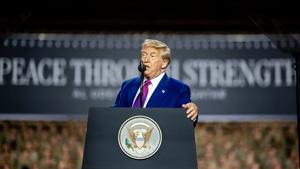
Concerning the subject, Trump said he recommends tax dollars being sent to “money sucking” insurance companies “in order to save the bad Healthcare provided by ObamaCare, BE SENT DIRECTLY TO THE PEOPLE SO THAT THEY CAN PURCHASE THEIR OWN, MUCH BETTER, HEALTHCARE, and have money left over.”
“In other words, take from the BIG, BAD Insurance Companies, give it to the people, and terminate, per Dollar spent, the worst Healthcare anywhere in the World, ObamaCare,” Trump said.



Sunny
Latest News Stories

Everyday Economics: A stalled labor market and why the next data points matter

Assaults against ICE up 1300%, vehicular attacks up 3200%, death threats up 8000%
Bipartisan bill to cap annual deficits at 3% could curb debt growth

One year in, a ‘ho-hum’ jobs report
Five battleground governor’s races for 2026

Chicago Flips Red calls for audit after public schools report

Capital Imp Committee: Begins Drafting Policy to Regulate Artificial Intelligence in County Government

Public Health Committee Chair Demands Animal Control Agreements for Crete, Monee

Public Works Committee Considers Taking Over Kankakee County Line Road to Expedite Bridge Repairs
Trump signs order protecting Venezuelan oil revenue from legal claims

Retirements and resignations to impact midterms as balance of power at stake

U.S. Supreme Court to hear anti-oil cases with energy costs on the line

Constitutional concerns raised over Illinois’ first civil hate crime case

Peotone Man Charged With Disorderly Conduct, Criminal Damage at New Lenox Target