Congress used government funding bill to ‘erase’ $3.4 trillion in deficits
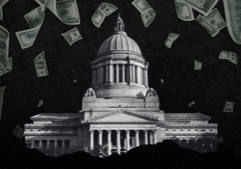
Quietly tucked inside Republicans’ funding deal to end the government shutdown is a provision wiping the congressional Pay-As-You-Go (PAYGO) scorecard, effectively forgiving nearly $3.4 trillion in deficits.
When Republicans passed their budget reconciliation bill in July, which included a permanent extension of the 2017 tax cuts, they broke precedent by operating under current policy baseline. This accounting method treats tax cut extensions as a continuation of current policy that costs nothing, rather than new policy that decreases federal revenues.
As a result, Senate Republicans were able to codify the tax cuts via a simple majority vote without having to fulfill reconciliation rules that require offsetting the deficit impact. Senators could not, however, bypass similar PAYGO rules unless they had 60 votes.
Under PAYGO, a law meant to ensure budget neutrality, the Office of Management and Budget records the deficit impact of legislation.
If Congress passes legislation that hikes mandatory spending or decreases revenue, and does not offset the deficits by the end of the year, automatic spending cuts to Medicare and other programs are triggered.
The tax cuts in the reconciliation bill added roughly $3.4 trillion to the PAYGO scorecard. But rather than finding offsets or accepting the automatic cuts to mandatory spending, Congress added a provision in the recent government funding bill – which fulfilled the 60-vote requirement – to reset the PAYGO scorecard to zero.
“That’s why this was included in the appropriations bill. It had nothing to do with appropriations,” Romina Boccia, director of budget and entitlement policy at the Cato Institute, told The Center Square. “It was all about getting those 60 votes, because that’s what PAYGO requires in order to eliminate those required spending reductions that would have been triggered by the Republicans’ reconciliation bill.”
This is hardly the first time Congress has wiped the PAYGO scorecard to avoid the consequences of a bill’s deficit impact.
In fact, Congress has never allowed the automatic spending cuts to take effect. Lawmakers wiped the PAYGO scorecard for the 2017 Tax Cuts and Jobs Act and the American Rescue Plan, while simply excluding both the CARES Act and the CHIPS and Science Act from the scorecard.
“There’s a lot of hand-waving when it comes to these deficits, but unfortunately, because Congress has pretty much consistently eliminated the spending cuts from the PAYGO scorecard in all instances – whether the Democrats put the deficits on there, or the Republicans – there’s been very little fight on it,” Boccia said.
“What it tells us is that PAYGO has become completely worthless, and that we should replace it and stop pretending like we have a deficit-controlling rule on the books when it’s pretty much understood that it will always be negated,” she added.
The U.S. racked up close to $2 trillion in net federal deficits during fiscal year 2025, according to the Congressional Budget Office, causing the national debt to top $38 trillion in October.


Sunny
Latest News Stories
Land Use Committee Advances Mokena Scrap Yard and Homer Glen Landscape Business Over Local Objections
District 210 Reports Insurance Deficit Amid National Healthcare Cost Spikes; Finances Remain Stable

Foxx to face questions about murder conviction review ‘investigations’

Illinois Quick Hits: North Chicago manufacturing expansion announced
Local government advocates oppose Pritzker plan to cut distributions

New Lenox Fire District Exploring Land Swap with Village for New Training Facility
WATCH: Illinois diversity leaders dodge questions as they slip farther from goals
Illinois Quick Hits: Road fund could help renovate Soldier Field

Planning Commission Backs 5-MW Peotone Solar Farm; Developer Pledges Pollinator Habitat and Community Funds
Joliet Junior College Board Approves $2 Tuition Increase Amidst Heated Debate Over Enrollment and Spending
New Lenox District 122 Kicks Off 2026-2027 Budget Cycle, Approves Minor Registration Fee Increase
New Lenox Park District Outlines Aggressive 2026 Development Plan, Addresses Crossroads Sinkhole

New Lenox Library Explores Rebranding Ahead of 25th Anniversary on the Commons
Lincoln-Way Board Ratifies Three-Year Support Staff Contract with Significant Hourly Raises