Large naval presence in Caribbean ahead of Ford arrival
As the number of suspected narcotic transport boats destroyed by the U.S. military grows, so does the number of naval vessels in the Caribbean.
Secretary of War Pete Hegseth announced on social media Thursday evening that U.S. forces carried out their 17th strike on alleged drug boats, killing three “male narco-terrorists” in the targeted operation.
President Donald Trump has made it clear that his administration’s intent to target narco-terrorists in the region to help curb the flow of drugs into the country.
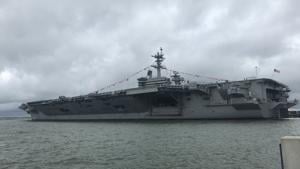
Last month, it was announced that the newest and largest U.S. Navy Aircraft carrier, the USS Gerald Ford, and its strike group would be transiting to the SOUTHCOM area of responsibility in the Caribbean.
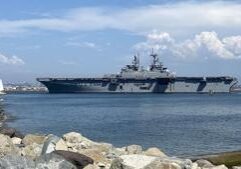
Ahead of the Ford’s arrival, several naval ships are already in the region, including the USS Iwo Jima Amphibious Ready Group, according to the U.S. Naval Institute—the Iwo Jima, a Wasp-class amphibious ship, among the larger classes of ships in the Navy.
The Iwo Jima Amphibious Ready Group deployed in August, carrying over 4,500 sailors and Marines, according to the Department of War. The group includes the Iwo Jima, USS Fort Lauderdale, USS San Antonio, and the 22nd Marine Expeditionary Unit.
As of early this week, the USNI reported that, in addition to the group, three Navy guided-missile destroyers are operating in the Caribbean, including the USS Jason Dunham, USS Gravely, and USS Stockdale. In addition, USNI reported the USS Lake Erie (CG-70) and the USS Wichita (LCS-13) are operating in the Caribbean.
The buildup of navy ships in the region points to the administration’s commitment to prioritizing targeting narco-terrorists. Still, it could also signal the U.S. focusing on potential adversarial threats in Latin America.
Hegseth told The Center Square last month at an event in the White House that the Department of War is keeping its eyes on adversaries in the region after TCS asked the secretary and the president if they had plans to expand U.S. Naval operations in Puerto Rico, specifically Roosevelt Roads, a Navy base closed in 2004.
“We’re familiar with the location that you’re referring to, and we will make sure that we’re properly placed in order to deal with the contingency we’re dealing with there, and also any ways in which other countries would attempt to be involved also, so we can walk and chew gum. We’re definitely keeping our eyes on near peer adversaries at the same time,” Hegseth told TCS.
The secretary’s response cemented the administration’s “America first” policy, which is beginning to shift focus to its “own backyard.”
“But we think sending a message on these cartels, these narco-terrorists, is an important, important inside our hemisphere, which for far too long other presidents, as the president pointed out, they’ve ignored our own backyard and allowed other countries to increase their influence here, which only threatens the American people. We’re changing that,” Hegseth concluded.
The naval buildup in the region could highlight concerns in recent years that Venezuela, under the dictatorship of socialist Nicolas Maduro, has aligned the country with American adversaries, such as Russia, China and Iran.
In 2022, Venezuela hosted military drills with countries including Russia, China and Iran.
The Center for Strategic and International Studies warns that Latin America is ripe for U.S. adversarial influences.
“While Western observers have focused their attention on joint connivances of Russia and Iran in Eastern Europe, Eurasia, and the Middle East, where Russo-Iranian military-security operations directly affect U.S. and European interests, the Western Hemisphere is not isolated from the two countries’ quests for global influence. In fact, in many ways it is an essential piece of the puzzle. First, both Iran and Russia perceive Latin America and the Caribbean (LAC) as a fertile ground for exploiting popular resentment vis-à-vis the United States and the ‘collective West,’ which they – rather successfully – harness to advance their view of a multipolar world,” according to CSIS.
The group cites sanctions from the West, which are growing in large part due to Russia’s ongoing offensive in Ukraine.
“Second, LAC partners could prove instrumental in offsetting the impacts of Western sanctions against Moscow and Tehran by mitigating their diplomatic and economic isolation. Finally, certain LAC countries could also serve as less scrutinized partners for further developing Russo-Iranian warfare capabilities or cooperation, sheltering mercenaries or militias – such as Hezbollah – and acting as vectors for ‘horizontal escalation’ of conflicts in which Russia and Iran are currently involved,” the group added.
According to USNI, the Ford is transiting from the Mediterranean to the Atlantic, where it will continue to the Caribbean.


Showers And Thunderstorms Likely
Latest News Stories
Trump makes history at Supreme Court amid landmark birthright citizenship challenge

New Hampshire school district sued over transgender policies
Trump watches as high court hears challenge to his birthright citizenship order

Combined Shutout, Early Offensive Burst Propel Brother Rice Past Lincoln-Way Central 7-0
Illinois Quick Hits: Prtizker says Trump order is unconstitutional

Karales’ Six RBIs, Lee’s Two Homers Power Lincoln-Way Central to 15-2 Tournament Rout of Joliet Catholic

U of I pressed on costly abandoned development project, stance on DEI directives
JJC Board Approves Fall 2026 Course Fees Amid Debate Over Student Costs
Trump says Iran’s new leader wants ceasefire
‘Conversion therapy’ bans in IL, other states, in danger, after SCOTUS ruling
Lincoln-Way 210 Approves Student Registration and Meal Fee Increases for 2026-2027
County Board Approves Peotone Solar Farm Amid Debates Over Union Labor and Tornado Safety