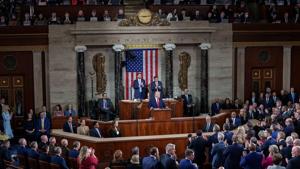
Supreme Court weighs challenge to Trump’s tariff power
President Donald Trump’s global tariffs are under question as the U.S. Supreme Court hears one of the most significant economic cases in decades with wide-ranging implications for the president’s foreign policy agenda and for businesses and consumers around the world.
Supreme Court justices challenged U.S. Solicitor General D. John Sauer with questions about his argument that Trump’s “Liberation Day” tariffs are a regulatory measure rather than a revenue-raising measure.
Sauer raised questions when he asserted that “raising revenue” was only incidental to Trump’s tariffs and that the primary purpose of the tariffs was regulatory in nature. Trump has boasted for months about how much money the tariffs are generating and has even floated the idea of rebating some of that money to taxpayers.
“These are regulatory tariffs, not revenue raising” tariffs, Sauer said. He added: “The fact that they raise revenue is only incidental.”
Chief Justice John Roberts signaled concern with key parts of the administration’s arguments. He noted that the International Emergency Economic Powers Act – the law Trump used to justify his worldwide tariffs – has never been used for tariffs in the past.
Roberts also brought up the the court’s major questions doctrine, which says that an issue of major national significance must be supported by clear congressional authorization. Further, Roberts noted that the 1977 law doesn’t mention tariffs and that taxation is the vehicle Trump is using to regulate foreign trade. He also asked Sauer: Who pays tariffs?
Sauer said that multiple parties pay the tariffs. The White House has insisted for months that foreign nations will pay the tariffs. Other studies and reports have suggested that consumers are picking up at least part of the costs of Trump’s tariffs.
Roberts said the statute seemed a “misfit” for the actions Trump has taken.
Justice Clarence Thomas used his first question to ask how the 1977 International Emergency Economic Powers Act would affect the major questions doctrine.
The Supreme Court’s liberal wing – Justices Sonia Sotomayor, Elena Kagan and Ketanji Brown Jackson – piled on questions. Sotomayor asked why Trump didn’t ban all foreign imports rather than tariff them. She also asked if former President Joe Biden’s student loan forgiveness plan would have worked if he had declared it an emergency first.
Trump declared twin emergencies – fentanyl smuggling and trade deficits – to justify his tariffs.
Supreme Court Justice Neil Gorsuch asked if the law would allow a president to put a 50% tariff on automobiles after declaring climate change to be an emergency.
Sauer said it would.
A group of Democrat-led states, five small businesses and two Illinois-based toymakers have challenged President Donald Trump’s authority to impose tariffs without Congressional approval under a 1977 law. That law, the International Emergency Economic Powers Act, doesn’t mention the word “tariff” and has never been used to impose tariffs. They argue that only Congress has the power of the purse and that Trump can’t impose tariffs without approval from Congress.
However, Trump’s legal team argues that the law is a clear delegation of emergency power, granting the president broad authority to act in times of crisis. Trump has declared persistent trade deficits and fentanyl smuggling to be emergencies. The U.S. has posted trade deficits every year since 1975. Trump said the situation became an emergency shortly before he took office for his second term.
Trump has used tariffs to try to reorder global trade to give U.S. businesses a home-field advantage. Trump put import duties on every U.S. trading partner, but American companies say they are the ones paying the new taxes. In some cases, companies pass the added costs to consumers, who were already frustrated by high prices before Trump took office in January.
Trump has predicted dire consequences if the Supreme Court were to strip his authority to impose tariffs. In August, Sauer and Assistant Attorney General Brett Shumate warned the U.S. Court of Appeals for the Federal Circuit that tariffs must stay in place to prevent a financial disaster.
“Suddenly revoking the President’s tariff authority under IEEPA would have catastrophic consequences for our national security, foreign policy, and economy,” they wrote in a letter. “The President believes that our country would not be able to pay back the trillions of dollars that other countries have already committed to pay, which could lead to financial ruin.”
In August, the U.S. Court of Appeals for the Federal Circuit affirmed a previous lower court ruling, but said Trump’s tariffs could remain in place while the administration appeals to the U.S. Supreme Court. In the 7-4 decision, the majority of the Federal Circuit said that tariff authority rests with Congress.
Tariffs are already becoming a go-to source of revenue for the administration. A report from U.S. Customs and Border Protection shows the U.S. has collected nearly $90 billion in tariffs through September. Trump has said he wants to use the revenue to reduce the income tax burden on American families and pay down the federal debt, which recently topped $38 trillion.
An August report, from the Congressional Budget Office, estimated tariffs could bring in $4 trillion over the next decade. That CBO report came with caveats and noted that tariffs will raise consumer prices and reduce the purchasing power of U.S. families.
A tariff is a tax on imported goods that is paid by the person or company importing the goods. The importer can absorb the cost of the tariffs or attempt to pass it on to consumers through higher prices.

Isolated Rain Showers then Partly Sunny
Latest News Stories

Meeting Summary and Briefs: New Lenox Public Library District Board of Trustees for January 19, 2026

Board Approves $479,000 Wireless Network Overhaul to Replace Aging Tech

California lawmakers talk about impacts of H.R. 1 for food aid

FBI searches Los Angeles schools superintendent’s home

Illinois quick hits: Guaranteed income for moms on Medicaid

Trump administration halts $259M in Medicaid funds to Minnesota
State of Union criticized by Southwest Dems, praised by GOP
Consumer advocates, Illinois lawmakers target ‘unnecessary’ utility costs
Large taxpayer costs coming to Indiana or Illinois for new Bears stadium
Trump’s tariffs set to rise to 15% for some countries, Greer says
Clintons to face questions from lawmakers this week over Epstein ties
Auditor general nomination approved unanimously in Illinois