
Foreign leaders wait for ruling in U.S. case on Trump’s tariff power
Foreign leaders are watching a U.S. appeals court that could upend President Donald Trump’s overhaul of global trade, held up by the tariff authority challenged in the case.
Trump recently warned that an adverse ruling could put the nation on course for another “Great Depression.” The U.S. Court of Appeals for the Federal Circuit hearing is considering a legal challenge to Trump’s ability to impose tariffs. Trump is worried about the court’s eventual decision, although his attorneys plan to appeal to the Supreme Court if the ruling doesn’t go Trump’s way.
However, if the court curbs Trump’s tariff authority, much of his global work could be undone, said Phillip Magness, a senior fellow at the Independent Institute.
“If that is upheld, then every tariff he’s issued, every letter he’s granted, every so-called deal that he’s made since May could be voided,” he told The Center Square.
Trump used the International Emergency Economic Powers Act to underpin his “Liberation Day” tariffs. On April 2, Trump announced reciprocal tariffs on nearly all U.S. trading partners. He later suspended those higher tariffs, used the threat of higher taxes to get foreign nations to agree to new trade deals and then hit nearly 66 nations plus the European Union with the highest tariffs in nearly a century.
Trump could use other tariff authority if the court rules against him, but those statutes aren’t nearly as attractive IEEPA, Magness said.
“There are a few other different clauses that exist, but all of these clauses have much more stringent rules in place to use them, so they have to have a formal regulatory investigation to determine that the criteria are met. A lot of them require that [Trump] go and report these findings to Congress and give Congress some say in it. And some of them have restrictions on them, like 150 day restriction on how long the tariffs can last on one of the balance of payment clauses that he could use,” Magness said. “So if Trump goes that route and tries to replace the IEEPA tariffs, now he has a very heavy bureaucratic obstacle that he has to work through, and that’s precisely why he went with IEEPA instead, it was just a way to sidestep all of the rules that were in place.”
Working with Congress could be challenging for Trump, given the GOP’s narrow margins in both legislative chambers.
“I don’t think at the moment, he has the votes to win tariff approval outright in Congress,” Magness said.
In May, the three-judge panel on the U.S. Court of International Trade unanimously ruled that Congress did not give the president tariff authority under the International Emergency Economic Powers Act of 1977. The ruling voided Trump’s “Liberation Day” tariffs and struck down other tariffs Trump issued under the IEEPA.
The administration appealed to the Federal Circuit, which ruled that Trump’s “Liberation Day” tariffs could remain in place while the legal challenge continued.
Appellate court judges scrutinized Trump’s tariff authority during oral arguments at the end of July. Judges asked attorneys on both sides of the case tough questions about the president’s authority to restructure global trade without help from Congress.
With a quick decision expected, leaders around the world are watching, Magness said.
“They’re paying attention because that determines the future of their relations with the United States,” he said.
So far, much of what Trump has done with global leaders amounts to a handshake deal dependent on a court ruling, Magness said.
“He has not released the text of a single one of these alleged deals. You know, we started with it was going to be 90 deals in 90 days, and then it turned into about four or five deals in 90 days, and not a single one of them has been printed on paper,” he said. “So you overlay that with the fact that nothing has been signed, nothing’s on paper, so we don’t even know what could be enforced. I don’t think these deals are worth anything. They’re basically just rhetoric.”




Mostly Sunny
Latest News Stories

Everyday Economics: A stalled labor market and why the next data points matter

Assaults against ICE up 1300%, vehicular attacks up 3200%, death threats up 8000%
Bipartisan bill to cap annual deficits at 3% could curb debt growth

One year in, a ‘ho-hum’ jobs report
Five battleground governor’s races for 2026

Chicago Flips Red calls for audit after public schools report

Capital Imp Committee: Begins Drafting Policy to Regulate Artificial Intelligence in County Government

Public Health Committee Chair Demands Animal Control Agreements for Crete, Monee

Public Works Committee Considers Taking Over Kankakee County Line Road to Expedite Bridge Repairs
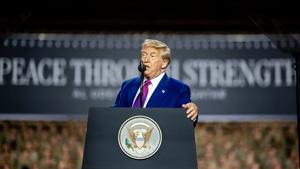
Trump signs order protecting Venezuelan oil revenue from legal claims
Retirements and resignations to impact midterms as balance of power at stake
U.S. Supreme Court to hear anti-oil cases with energy costs on the line

Constitutional concerns raised over Illinois’ first civil hate crime case

Peotone Man Charged With Disorderly Conduct, Criminal Damage at New Lenox Target