Will County Animal Protection Services Seeks New Facility Amid “Gaping Wound” of Space Crisis
Article Summary:
Will County Animal Protection Services is seeking approval for a new facility, telling a county committee that its current building is critically inadequate for housing animals, leading to severe operational challenges and the suspension of its public adoption program. Administrator Anna Payton described the situation as a “gaping wound” that stop-gap measures can no longer fix.
Will County Public Health & Safety Committee Key Points:
-
The department’s current building, not designed to house animals, dedicates only 3% of its footprint (225 square feet) to animal holding, causing major plumbing, HVAC, and sewer problems.
-
Due to severe overcrowding, the department has suspended its public adoption program, is housing animals off-site, and cannot expand services to other municipalities.
-
The department is self-funded primarily through rabies tag registrations and is asking for county board approval to spend its own money on a new capital project, not for a general fund allocation.
JOLIET, IL – Will County Animal Protection Services is facing a severe space crisis in a facility that was never designed to house animals, forcing the department to suspend its public adoption program and turn away municipalities seeking its services.
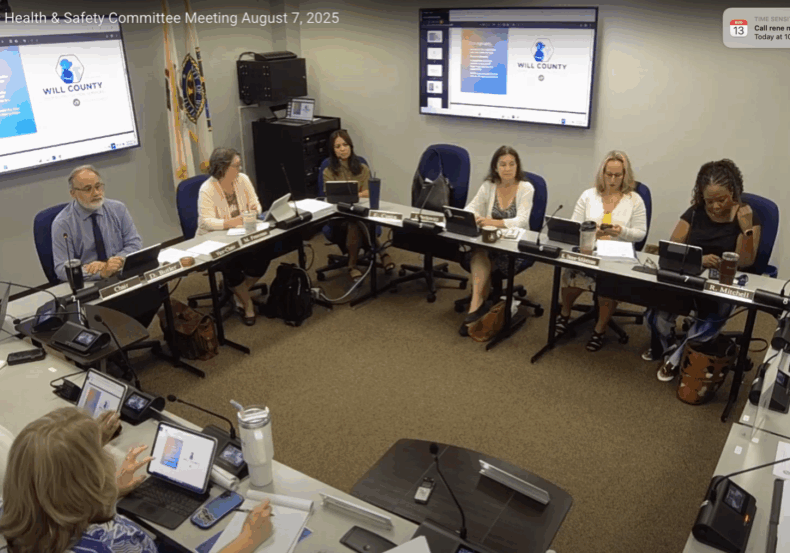
During a presentation to the Will County Board Public Health & Safety Committee on Thursday, Animal Protection Services Administrator Anna Payton detailed a litany of problems stemming from their building’s inadequacy, calling it a “gaping wound” that requires more than a Band-Aid solution.
“Our building was not built to house animals. I can’t emphasize that enough,” Payton said. “Three percent of the footprint of our building was built to house animals. That is 225 square feet out of a 6,700-foot building.”
Payton explained that the building, constructed before the department began housing animals on-site post-COVID, has only five small kennels intended for short-term, post-operative recovery, not for seven-day stray holds. With the department taking in 870 domestic animals in 2024—including dogs, cats, rabbits, chickens, and guinea pigs—the space is completely insufficient.
Efforts to retrofit two garages with kennels have provided temporary relief but have led to significant infrastructure failures, including HVAC issues and sewer problems that are not designed to handle animal waste. Payton noted one estimate to fix the plumbing alone was $55,000.
“It’s just not sustainable and it’s not built to house what we need,” she said.
The chronic overcrowding has had significant consequences. Payton announced that the department has temporarily suspended its adoption program, which just began in 2024, and is now contracting with an organization in Naperville to house its animals off-site. Furthermore, the lack of space prevents the department from entering into intergovernmental agreements with other municipalities that need animal control services.
The location itself presents challenges, as the building is situated next to the sheriff department’s gun range. “The guns going off is not only frightening to the animals, but it’s unsettling to the people that come in,” Payton said, adding it undermines the welcoming environment needed for adoptions and public engagement.
The issue was highlighted by a recent cruelty case where the department had to house 13 chickens as evidence. “We’re having those in our third garage bay. So, we’re operating over capacity, inappropriate housing for those animals,” she said.
Despite the challenges, Payton highlighted numerous successes, including a rebranding from “Animal Control,” updated ordinances, and partnerships with Joliet Junior Community College and Wilco for student training. The department also runs the “Whiskers at Work” program, which places feral cats as working mousers on farms, and has provided free microchips to nearly 400 pets in two years.
Payton is asking the county board for budget approval to pursue a new facility. As a self-sufficient department funded by rabies tag registrations and not taxpayer dollars from the general fund, it needs the board’s authorization to spend its own money on a major capital project.
Committee Chair Daniel J. Butler (R-Frankfort) and other members appeared supportive. “I get a pretty good idea that pretty much people are in favor of that,” Butler said. He asked Payton to return next month with a formal proposal to be submitted for the county’s capital budget.
Payton suggested an ideal location would be centralized, in a nicer area that feels like a “community destination,” and has adequate space for volunteers, educational programs, and proper housing for various species, including livestock.




Sunny then Slight Chance Showers And Thunderstorms
Latest News Stories
Everyday Economics: A stalled labor market and why the next data points matter
Assaults against ICE up 1300%, vehicular attacks up 3200%, death threats up 8000%
Bipartisan bill to cap annual deficits at 3% could curb debt growth

One year in, a ‘ho-hum’ jobs report
Five battleground governor’s races for 2026
Chicago Flips Red calls for audit after public schools report

Capital Imp Committee: Begins Drafting Policy to Regulate Artificial Intelligence in County Government

Public Health Committee Chair Demands Animal Control Agreements for Crete, Monee

Public Works Committee Considers Taking Over Kankakee County Line Road to Expedite Bridge Repairs

Trump signs order protecting Venezuelan oil revenue from legal claims
Retirements and resignations to impact midterms as balance of power at stake
U.S. Supreme Court to hear anti-oil cases with energy costs on the line

Constitutional concerns raised over Illinois’ first civil hate crime case
Peotone Man Charged With Disorderly Conduct, Criminal Damage at New Lenox Target