Will County Board Gets Back to Basics with Robert’s Rules of Order Training
Article Summary: The Will County Board Committee of the Whole received a detailed training session on Robert’s Rules of Order from parliamentary expert Matthew Prochaska to clarify procedures for conducting meetings. The session, prompted by requests from board members, covered the fundamentals of making motions, the nuances of debate, and the proper ways to maintain decorum and handle disagreements.
Will County Board Parliamentary Procedure Key Points:
-
Matthew Prochaska, a registered parliamentarian and Kendall County Circuit Clerk, led the informational session.
-
Key topics included the hierarchy of motions, such as the difference between tabling an item and postponing it to a specific time.
-
Members engaged in an extensive Q&A, asking for clarification on amending motions, calling the question to end debate, and the process for reconsidering a previously passed item.
-
The training emphasized that formality, such as addressing all comments through the chair, is meant to preserve members’ rights and facilitate orderly business, not to complicate proceedings.
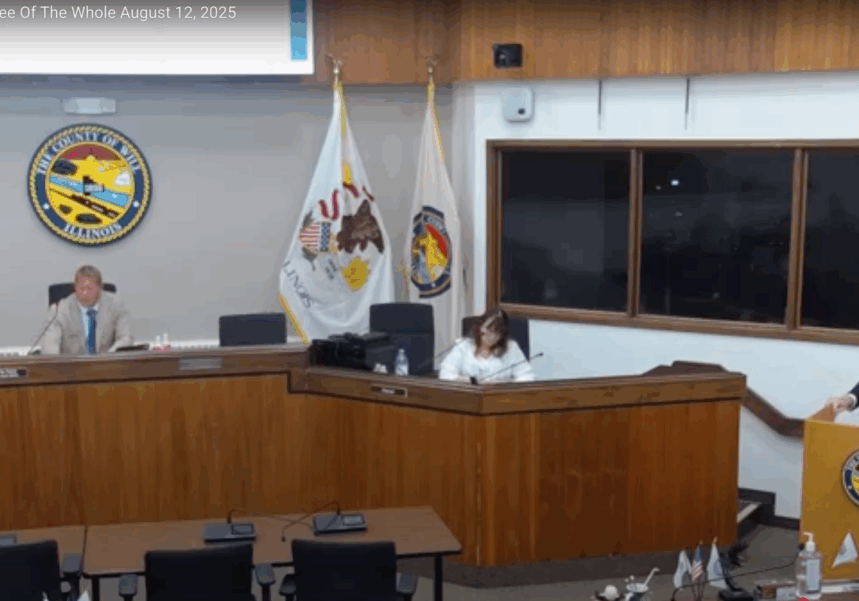
JOLIET, IL — Seeking to ensure smoother and more effective meetings, Will County Board members participated in a comprehensive refresher course on Robert’s Rules of Order and parliamentary procedure during their Committee of the Whole meeting on Tuesday.
At the request of board members, Speaker Joe VanDuyne (D-Wilmington) invited Matthew Prochaska, the Kendall County Circuit Clerk and a registered parliamentarian, to lead the informational session. Prochaska, who previously served on the Kendall County Board for eight years, guided the committee through the principles of structured debate, formal motions, and maintaining decorum.
“Robert’s rules is meant to be have more of a formality to proceedings,” Prochaska explained. “And it’s to maintain decorum, to preserve members rights, and to facilitate a smooth and orderly transaction of business. It is really not designed at all to impede business or to complicate the proceedings.”
Prochaska stressed that all communication during formal debate should be directed through the presiding officer, referred to as “Mr. or Madam Speaker” or “the chair,” rather than directly between members. This practice, he noted, helps associate the individual with the position and prevents discussions from becoming personal or heated.
The session quickly turned interactive, with numerous board members asking for clarification on specific, often complex, procedures they regularly encounter.
“I think that this board could… use more of the points of orders, how to conduct ourselves, when it’s appropriate to interrupt and when it’s not,” said Mica Freeman (D-Plainfield), kicking off the Q&A.
One area of detailed discussion was the difference between various types of motions. Prochaska clarified that a motion to “lay on the table” sets an issue aside indefinitely within the current two-year board session and requires a future motion to be brought back. In contrast, a motion to “postpone to a certain time” is often more practical, as it schedules the item for a specific future meeting.
Members also sought to understand the rules of debate. Prochaska reminded them that under Robert’s Rules, a member may speak twice on a single motion for up to 10 minutes each time, and cannot speak a second time until all other members wishing to speak have had a chance. Ending debate by “calling the question” is not automatic; it requires a two-thirds vote of the assembly.
The process for revisiting a past decision drew several questions. Prochaska explained that a motion to “reconsider” can only be made by a member who was on the prevailing side of the original vote and must be done on the same day or at the very next meeting. For items from farther in the past, a motion to “rescind” can be used, but not if substantial action, such as signing contracts or cutting checks, has already been taken.
Daniel J. Butler (R-Frankfort) asked about the importance of keeping discussion “germane” to the topic at hand, which Prochaska confirmed is a key responsibility of the chair.
“Everything has to be germane to the topic at hand,” Prochaska said. “I don’t want to be discussing a zoning matter and then all of a sudden go start devolving into the price of widgets in China.”
Speaker VanDuyne concluded the session by thanking Prochaska and reminding the board that the training was meant to serve as a guideline for improvement.
“I don’t expect any chair to have this memorized,” VanDuyne said. “As long as we all can work together and try to run our meetings a little bit more smoother, it would be much appreciated.”




Showers And Thunderstorms
Latest News Stories
Land Use Committee Advances Mokena Scrap Yard and Homer Glen Landscape Business Over Local Objections
District 210 Reports Insurance Deficit Amid National Healthcare Cost Spikes; Finances Remain Stable
Foxx to face questions about murder conviction review ‘investigations’

Illinois Quick Hits: North Chicago manufacturing expansion announced
Local government advocates oppose Pritzker plan to cut distributions
New Lenox Fire District Exploring Land Swap with Village for New Training Facility
WATCH: Illinois diversity leaders dodge questions as they slip farther from goals
Illinois Quick Hits: Road fund could help renovate Soldier Field

Planning Commission Backs 5-MW Peotone Solar Farm; Developer Pledges Pollinator Habitat and Community Funds
Joliet Junior College Board Approves $2 Tuition Increase Amidst Heated Debate Over Enrollment and Spending
New Lenox District 122 Kicks Off 2026-2027 Budget Cycle, Approves Minor Registration Fee Increase
New Lenox Park District Outlines Aggressive 2026 Development Plan, Addresses Crossroads Sinkhole
New Lenox Library Explores Rebranding Ahead of 25th Anniversary on the Commons
Lincoln-Way Board Ratifies Three-Year Support Staff Contract with Significant Hourly Raises